Kovaloff’s nose
The NoseKovaloff’s nose is at once a missing part of the body, an independent social actor, and the measure of its owner’s dependence on rank and appearance. It is cut from a loaf of bread, appears in public as a state-councillor, rejects Kovaloff’s claim of ownership, and eludes ordinary repair. Its unexplained return restores Kovaloff’s face but leaves the story’s central absurdity intact: a familiar organ has behaved like a person whose official standing outranks the man it once belonged to.
Appearance and Social Meaning
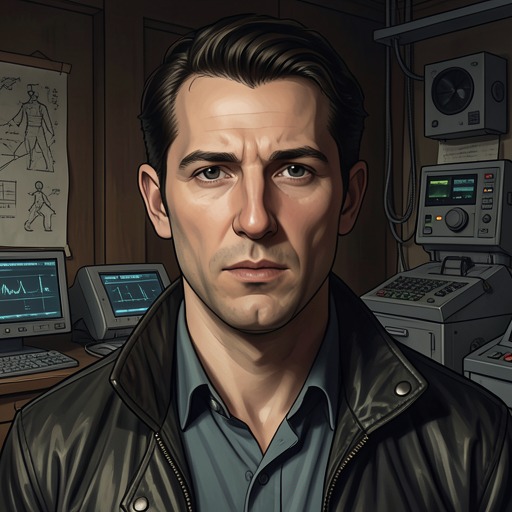
Before its separation, the nose is an ordinary feature with an unusually important place in Kovaloff’s self-presentation. Kovaloff, who had served as a committee-man in the Caucasus, insists on being called Major rather than committee-man, takes daily walks on the Neffsky Avenue, and cultivates the signs of standing: a stiff, clean collar, whiskers associated with officials, and seals bearing armorial devices or the days of the week. He has come to St Petersburg hoping for a position commensurate with his rank, preferably vice-governor, though he would accept a bailiff’s post. He is also willing to marry, provided a prospective wife brings a dowry of two hundred thousand roubles. The loss of his nose thus threatens not only bodily wholeness but the appearance on which his ambitions and social access depend.
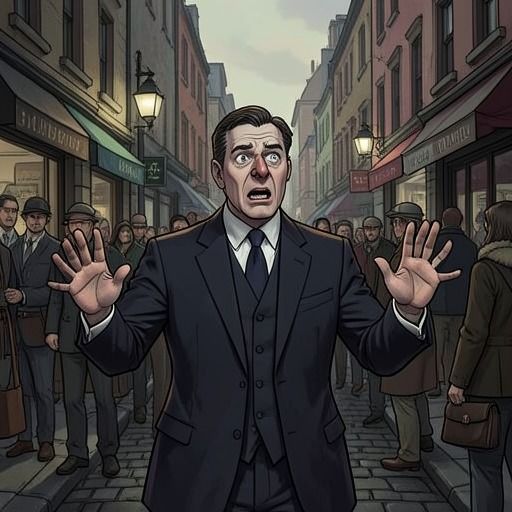
That dependence becomes explicit as soon as Kovaloff sees his face. He checks himself in a confectioner’s mirror and finds not a minor blemish but an absolute vacancy. He is particularly conscious of the social consequences: he calls weekly on Madame Tchektyriev, a state-councillor’s wife, knows Madame Podtotchina, a colonel’s wife with a pretty daughter, and has invitations to two parties. He protests that a nose is nearly equivalent to himself, not a dispensable part like a little toe. The organ’s significance is therefore measured both by its place in the face and by the relationships and occasions before which Kovaloff fears appearing without it.
Separation and Independent Life
The nose first enters the story in a domestic scene. Ivan Yakovlevitch, a barber, has put on a coat over his shirt and begun cutting bread at the table when he finds something whitish inside the loaf. He pokes at it with his knife and finger, then draws out a nose. He recognizes it as apparently belonging to an acquaintance. His wife reacts with disgust and accuses him of cutting off a customer’s nose, threatening to report him to the police and recalling complaints that he grips customers too tightly while shaving them. The episode’s concrete discovery is startlingly ordinary: a severed body part is embedded in breakfast bread, while the barber’s household immediately treats it as a criminal and domestic problem.
Kovaloff discovers the absence the same morning. He wakes, makes his habitual lip-trilling sound, and asks for a small mirror to inspect a heat-boil that appeared on his nose the previous evening. Instead he sees a smooth vacancy. After confirming the loss with water and a towel, he dresses and sets out for the police superintendent. When he encounters his nose outside a building, it has become a gentleman in uniform. Its gold-embroidered coat, stiff high collar, chamois-leather trousers, sword, and plumed hat mark it as a state-councillor. The nose makes duty calls, orders a coachman to drive, and examines wares in a shop before Kovaloff can confront it. A feature that had been part of its owner’s face now possesses the clothes, mobility, and public authority of a superior official.
Kovaloff tries to assert the bodily relationship directly, but the nose answers as though the two belong to separate administrative worlds. It asks what he wants, claims not to understand, and denies that there can be close relations between them. Judging by the buttons on Kovaloff’s uniform, it says, he must belong to a different department. The refusal turns a claim of physical ownership into a dispute over institutional identity: the nose’s uniform gives it an apparent rank that Kovaloff cannot overcome by insisting that it is his own. When Kovaloff turns away briefly to address a lady, the nose disappears again, evidently continuing its calls.
Attempts at Recovery and Repair
Kovaloff seeks official help first through a newspaper advertisement. He wants the paper to announce that whoever brings the absconded nose to him will be rewarded, but he avoids giving his name because he fears his lady friends will hear of the humiliation. He suggests that he be identified simply as a committee-man or, better, a Major. The official responsible for advertisements refuses: publishing such a notice might compromise the paper, especially when readers already accuse it of printing nonsense and lies. As an example, he recalls an earlier advertisement about a lost black-haired poodle that was understood as a satire about a cashier. Kovaloff insists that this is not a poodle but his own nose, almost himself; the distinction does not change the refusal. The newspaper’s concern with its own credibility leaves his extraordinary loss outside the categories it is willing to print.
His visit to the police commissary brings a different form of institutional dismissal. The commissary receives him coldly, says that the afternoon is not a suitable time for business, and remarks that respectable people do not have their noses stolen. Kovaloff is especially sensitive to any slight against his rank and social position, and takes the remark as an insult rather than assistance. He leaves with dignity, having received no remedy. Together, the newspaper and police episodes show the loss being filtered through institutional convenience and assumptions about respectability: one office refuses to publish it as implausible, while the other treats it as evidence against the claimant’s standing.
The police commissary later brings the nose back. He says it was arrested while trying to get into a carriage for Riga, travelling on a passport made out in the name of an official. He explains that he initially mistook it for a gentleman and recognized it only because he had his glasses. The supposed principal culprit, a barber on the Ascension Avenue, is locked up; the commissary says he had suspected the man of drunkenness and theft and that the barber had stolen buttons from a shop two days earlier. The nose itself is uninjured and arrives wrapped in paper. Kovaloff is delighted and offers the commissary tea, but recovery resolves only the question of custody. The nose still has to be put back.
Kovaloff’s attempts at reattachment fail. He carefully places the nose where it belongs, warms it with his breath, and tries again, but it will not stay. When he holds it to his mouth and tells it to hold on, it falls onto the table with a noise like a cork. He calls Ivan to fetch a doctor. The doctor examines the vacant place by turning Kovaloff’s face from side to side and flicking the spot where the nose used to be; the force makes Kovaloff’s head strike the wall. After another examination, the doctor declares that replacement cannot be done and warns that treatment could make matters worse. Kovaloff pleads that he must appear in good society and attend two parties that evening, offering to pay. The doctor declines to operate, advises him to wash the place with cold water and let Nature act, and suggests preserving the detached nose in spirits or warm vinegar with two spoonfuls of brandy. Even when it is physically recovered, the nose resists being reduced to a repairable object.
Return and Narrative Significance
The nose’s restoration is as abrupt and unexplained as its departure. On 7 April, Kovaloff wakes, looks in a mirror, and finds it back between his cheeks as if nothing had happened. He touches it to make sure, then washes and dries his face and checks again. The repeated inspection verifies the change, but no cause is supplied; the narration introduces the return as one of the strange and improbable events of the world. The nose has come back to its proper place without explanation after official recovery and practical reattachment have both failed.
Its episodes make social identity seem as removable and mobile as a bodily feature. The nose’s public authority rests on its uniform and apparent state-councillor rank, while Kovaloff’s anxiety centers on his own title, face, acquaintances, and prospects. Institutions offer no coherent route from loss to restoration: the newspaper rejects the notice, the commissary initially rebukes the complainant, police later recover the organ, and the doctor cannot restore it. The unexplained return overturns those procedural efforts rather than completing them. The nose is consequently more than a comic symbol of vanity: its independent career exposes the absurd instability beneath the status rituals that both it and Kovaloff use to claim recognition.